
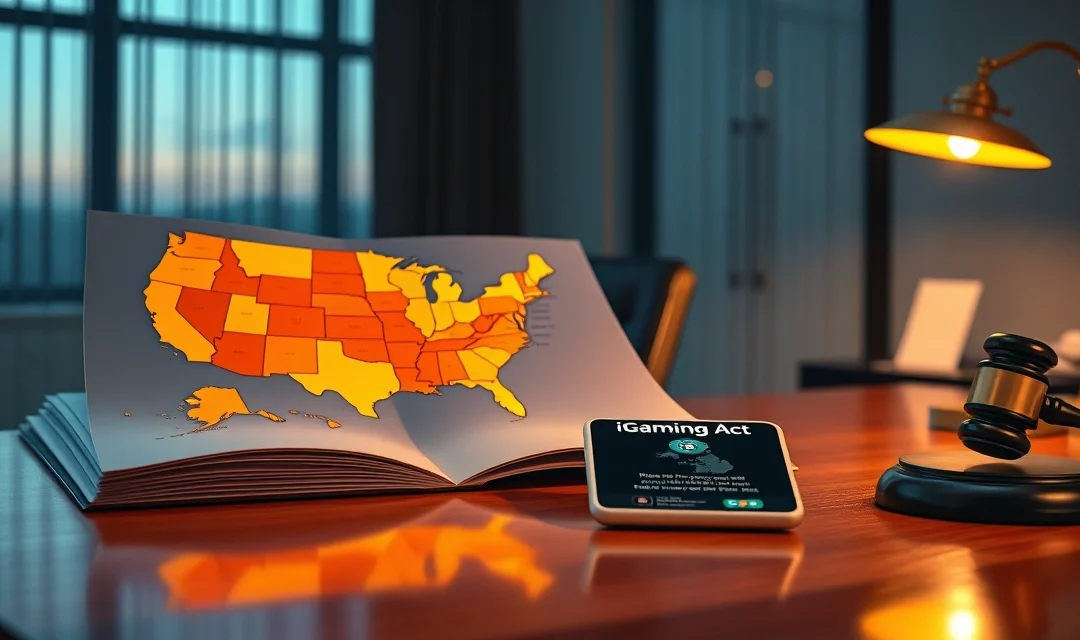
As of April 10, 2026, the map of legal online casino gambling in the United States looks strikingly different than it did even eighteen months ago. What began as a handful of pioneering jurisdictions has grown into a multi-billion-dollar regulated industry, with fresh legislative fights brewing in statehouses from Albany to Sacramento. For players, affiliates, journalists, and policy researchers, knowing exactly which online casino legal states currently permit real-money play — and under what terms — has become essential.
This comprehensive 2026 reference guide breaks down every U.S. state with regulated iGaming, every jurisdiction actively debating legalization, and the tax, licensing, and consumer-protection frameworks that define each market. You will find current statistics from the American Gaming Association, state gaming control boards, and independent analysts, along with practical takeaways for players choosing where and how to play legally. Whether you are a first-time bettor verifying your home state’s status or a seasoned affiliate tracking the regulatory horizon, this guide delivers the authoritative picture of online casino legal states as the industry enters the second quarter of 2026.
The Current State of Online Casino Legalization in America
The United States has always taken a federalist approach to gambling regulation, and iGaming is no exception. There is no federal statute that authorizes or prohibits online casino play nationwide; instead, each state legislature decides whether to license, tax, and regulate the vertical. Under the Department of Justice’s 2011 reinterpretation of the Wire Act, states gained the freedom to permit intrastate online gambling, a door that New Jersey, Delaware, and Nevada walked through in 2013.
Thirteen years later, the iGaming footprint has grown cautiously but steadily. According to the American Gaming Association’s 2025 State of the States report, regulated online casinos generated more than $8.4 billion in gross gaming revenue across legal jurisdictions in 2025, a 24 percent year-over-year increase. Pennsylvania, Michigan, and New Jersey collectively account for roughly 82 percent of that total, with the remaining share distributed among a small group of newer and smaller markets. The pattern is clear: where lawmakers have chosen to regulate, consumer demand has exceeded even the most optimistic fiscal projections.
Still, the vast majority of Americans cannot legally play real-money slots, table games, or live-dealer products online from within their home state. That disparity is the central tension shaping the 2026 legislative calendar, and it is why “legal online casinos by state” has become one of the most frequently searched phrases in the U.S. gambling niche.
States Where Online Casinos Are Legal in 2026
As of April 10, 2026, seven U.S. states operate fully regulated online casino markets offering slots, table games, and live-dealer products for real money. An eighth, Nevada, allows online poker but has not authorized interactive casino gaming. Each of these online casino legal states maintains its own licensing regime, tax rate, and operator roster, and players must be physically located within state borders to place a wager, verified through geolocation software required by law.
The Seven Fully Regulated iGaming Jurisdictions
The current roster of fully regulated markets includes New Jersey, Pennsylvania, Michigan, West Virginia, Connecticut, Delaware, and Rhode Island. Rhode Island, the most recent addition, launched its iGaming market in March 2024 under a single-operator model tied to Bally’s, and 2025 became its first full calendar year of operation. The remaining six have multi-operator competitive frameworks with between three and more than twenty licensed platforms per state.
A Snapshot of Every Legal Market
| State | Year Launched | Regulator | Tax Rate | 2025 GGR (est.) |
|---|---|---|---|---|
| New Jersey | 2013 | NJ Division of Gaming Enforcement | 17.5% | $2.41 billion |
| Pennsylvania | 2019 | PA Gaming Control Board | 54% slots / 16% tables | $2.18 billion |
| Michigan | 2021 | MI Gaming Control Board | 20–28% tiered | $2.31 billion |
| West Virginia | 2020 | WV Lottery Commission | 15% | $238 million |
| Connecticut | 2021 | CT Department of Consumer Protection | 18% (25% after 2026) | $612 million |
| Delaware | 2013 | DE Lottery | State revenue-share model | $51 million |
| Rhode Island | 2024 | RI Division of Lotteries | 61% slots / 15.5% tables | $96 million |
The figures above are drawn from each state regulator’s monthly revenue disclosures and the American Gaming Association’s 2025 annual report. They illustrate the disproportionate weight of New Jersey, Pennsylvania, and Michigan, but they also highlight how even smaller markets like West Virginia and Connecticut are quietly producing hundreds of millions in annual revenue.
A State-by-State Breakdown of Regulated iGaming Markets
Each of the seven regulated iGaming jurisdictions has developed its own character. The operators, product mix, and consumer-protection rules vary meaningfully from state to state, and understanding those differences matters for players choosing where to sign up and for affiliates evaluating the competitive landscape.
New Jersey: The Blueprint for American iGaming
New Jersey remains the unquestioned leader among online casino legal states. The Garden State authorized intrastate online gambling in 2013, and its market has matured into a sophisticated, hyper-competitive environment with more than thirty licensed skins operating under the Atlantic City casino tethering model. In 2025, New Jersey’s online casino operators produced $2.41 billion in gross gaming revenue, the highest single-state total in the country. Top performers include BetMGM, FanDuel Casino, DraftKings, Golden Nugget, and Borgata, with the top five operators capturing approximately 78 percent of market share. The New Jersey Division of Gaming Enforcement, widely considered the gold standard among American gaming regulators, publishes detailed monthly revenue data and actively polices advertising, responsible-gambling compliance, and game fairness.
Pennsylvania: The Highest-Taxed, Fastest-Growing Market
Pennsylvania’s 54 percent tax on online slot revenue is the highest in the regulated world, yet operators keep launching and players keep depositing. The Keystone State crossed the $2 billion GGR mark in 2024 and grew another 9 percent to $2.18 billion in 2025, narrowly trailing New Jersey for second place. Pennsylvania’s success demonstrates that even punishing tax rates cannot suppress consumer demand in a large, populous state with a strong retail-casino tradition. Licensed operators include Hollywood Casino, FanDuel, BetMGM, DraftKings, and PokerStars Casino, and the Pennsylvania Gaming Control Board continues to issue licenses to new entrants as tethered partners become available.
Michigan: The Model of Balanced Regulation
Michigan is often cited by industry analysts as the best-designed iGaming framework in the country. Launched in January 2021, Michigan’s market pairs a reasonable tiered tax structure (20 to 28 percent) with permissive promotional rules, interstate poker liquidity through the Multi-State Internet Gaming Agreement, and strong consumer protections administered by the Michigan Gaming Control Board. In 2025, Michigan produced $2.31 billion in GGR, narrowly passing Pennsylvania in some monthly rankings and confirming its position as a top-tier market. For players, Michigan offers one of the deepest game libraries in the nation, with more than 4,500 unique slot titles spread across licensed operators.
States Considering Online Casino Legalization in 2026
The 2026 legislative calendar is the busiest in iGaming history. According to tracking by the American Gaming Association and the National Council of Legislators from Gaming States, at least eleven states are actively debating online casino bills in 2026, and several have advanced legislation beyond the committee stage.
- New York: Senate Bill S1963, carried over from 2025, would authorize up to ten iGaming licenses tethered to existing commercial and tribal operators, with a 30.5 percent tax rate. Legislative analysts project first-year revenue of $1.1 billion.
- Maryland: Following the failure of the 2024 ballot referendum, lawmakers reintroduced HB 17 in January 2026, proposing a 20 percent tax rate and a statewide launch no earlier than Q4 2027.
- Illinois: Representative Edgar Gonzalez’s Internet Gaming Act received a favorable committee vote in March 2026, setting up a potential floor vote before the spring session adjourns.
- Massachusetts: A Joint Committee on Economic Development study bill is examining an iGaming framework that would include mandatory affordability checks, a first for the U.S. market.
- Indiana: HB 1432 passed the House Public Policy Committee in February 2026 but stalled in appropriations; backers plan to push again in the 2027 session.
- Virginia, Iowa, Wyoming, Louisiana, Ohio, and Missouri: All six have active study groups or introduced bills in the current session, though none are considered likely to pass in 2026.
If any one of New York, Illinois, or Maryland crosses the finish line this year, the U.S. iGaming market could surpass $12 billion in annual GGR by 2028, according to projections from Eilers & Krejcik Gaming. That would make regulated online casinos the single fastest-growing segment of the American gambling industry.
Sweepstakes and Social Casinos: The Legal Gray Area
Beyond the seven fully regulated online casino legal states, a parallel industry operates under sweepstakes and social-gaming frameworks. Platforms like Stake.us, Chumba Casino, Pulsz, and McLuck use a dual-currency model — gold coins for free play and sweepstakes coins redeemable for cash prizes — that sidesteps traditional gambling statutes in most states. These operators accept customers in roughly 45 states, with a handful of notable exclusions including Washington, Idaho, Michigan, Nevada, and, following new guidance in late 2025, New York.
State attorneys general have grown increasingly skeptical of the sweepstakes model in 2025 and early 2026. California’s Department of Justice issued cease-and-desist letters to three major sweepstakes operators in February 2026, and legislative bills in Connecticut and Florida would explicitly classify dual-currency platforms as unregulated gambling. Players in non-legal iGaming states should monitor these developments closely, since a single enforcement action can disqualify a preferred platform overnight.
How the U.S. Compares to Global Online Casino Markets
The United States remains, by some measures, a laggard in the global iGaming landscape. In the United Kingdom, the entire country has operated a unified online casino market since 2005, regulated by the UK Gambling Commission. Across the European Union, most member states have moved to national licensing regimes over the past decade, and Canada’s Ontario market alone generates more annual revenue than all but the top three U.S. states combined.
For American players curious about mature, unified markets, comparison with the British system offers useful context. The UK model features standardized deposit limits, universal self-exclusion through GAMSTOP, and rigorous advertising rules that many U.S. state regulators are now studying. Our sister analysis on the best online casino UK landscape explores those differences in depth.
Globally, H2 Gambling Capital estimated online casino gross win at $87 billion in 2025, with the United States contributing approximately 10 percent despite representing more than 25 percent of global gambling spend overall. The gap is a direct function of how few states have legalized iGaming, and it is the reason operators, tax-revenue-hungry governors, and player advocates continue to push for expansion.
Licensing, Regulation, and Player Protection in Legal States
A regulated online casino in any of the seven U.S. iGaming jurisdictions must meet a rigorous set of requirements before it can accept a single real-money wager. These requirements include tethering to a licensed land-based casino (in most states), independent RNG and RTP testing by certified laboratories such as GLI or BMM Testlabs, SOC 2 compliant cybersecurity audits, and full KYC verification for every registered customer.
Players benefit from consumer protections that simply do not exist on offshore or gray-market sites. These include segregated player funds held in trust accounts, mandatory dispute-resolution procedures overseen by the state regulator, and enforceable rights to withdraw legitimately won funds. In New Jersey, for example, operators who fail to process a verified withdrawal within defined service-level agreements face escalating fines and potential license suspension. If you are weighing where to open an account, the seven-tips framework we use to evaluate the best online casinos remains a practical starting point.
Responsible Gambling Framework in Legal States
Every one of the seven online casino legal states requires licensees to provide robust responsible-gambling tools directly inside the player account interface. These tools typically include deposit limits, loss limits, session-time limits, self-exclusion, cool-off periods, and clear links to problem-gambling hotlines. New Jersey’s 1-800-GAMBLER hotline, operated by the Council on Compulsive Gambling of New Jersey, fielded more than 41,000 calls in 2025, a 14 percent increase over 2024, reflecting both greater awareness and the realities of a growing player base.
The National Council on Problem Gambling’s 2025 survey found that approximately 2.5 million U.S. adults met criteria for a gambling disorder, with another 5 to 8 million classified as at-risk. These figures underscore why responsible-gambling tooling is not a marketing afterthought but a legal prerequisite in every regulated American market. Players can access self-exclusion programs directly through state regulators or nationally via the National Council on Problem Gambling at ncpgambling.org.
Payment Processing and Banking in Online Casino Legal States
Players frequently ask why deposits and withdrawals at a licensed iGaming site are so much smoother than at offshore platforms. The answer is that regulated operators have direct relationships with major U.S. banks and payment processors, backed by state-issued licenses that satisfy the Unlawful Internet Gambling Enforcement Act. This allows for instant ACH transfers, debit and credit card deposits with a high approval rate, PayPal and Venmo integrations, VIP Preferred e-check processing, and same-day withdrawals via PayPal or branded prepaid cards such as Play+.
If you are new to funding a licensed online casino account, our guide on how to play with real money walks through the deposit process step by step, including identity verification and geolocation checks. These checks are required by state law and are the reason you can only play while physically located inside a legal state border.
Tax Revenue and Economic Impact by State
One of the strongest arguments legislators make in favor of legalizing online casinos is the tax revenue that flows directly into state coffers. In 2025, the seven regulated iGaming states collectively generated approximately $2.37 billion in direct state tax revenue from online casino operations, according to data compiled from each state’s monthly public disclosures.
| State | 2025 iGaming Tax Revenue | Primary Use of Funds | Direct Jobs Supported |
|---|---|---|---|
| Pennsylvania | $1.01 billion | Property tax relief, general fund | 3,400 |
| New Jersey | $422 million | Casino Revenue Fund (senior services) | 2,900 |
| Michigan | $546 million | School Aid Fund, Detroit services | 2,700 |
| Connecticut | $110 million | General fund, problem-gambling programs | 510 |
| Rhode Island | $58 million | General fund | 220 |
| West Virginia | $36 million | Lottery general fund | 190 |
| Delaware | $7.3 million | General fund | 65 |
Pennsylvania’s $1.01 billion haul is a direct consequence of its 54 percent slot tax, and it has become a reference point cited in every legislative hearing on the subject. For a state facing budget pressure, iGaming offers a politically attractive revenue stream that does not require a tax increase on the general population. The American Gaming Association’s full state-level data is publicly available at americangaming.org.
The Future Outlook for US Online Casino Legalization
Looking beyond 2026, industry analysts project that the U.S. iGaming market will continue to expand, though the pace of expansion will depend heavily on political dynamics in a small number of large states. Eilers & Krejcik Gaming’s 2026 forecast predicts that the legal footprint will include nine states by the end of 2027 and as many as twelve by 2030, generating more than $18 billion in annual gross gaming revenue at maturity.
The most likely near-term additions are, in order of legislative probability: Maryland, Illinois, New York, and Indiana. Each faces distinct political obstacles — Maryland needs a second ballot referendum, Illinois must navigate opposition from retail-casino labor interests, New York must reconcile tribal compacts with commercial license proposals, and Indiana must overcome appropriations-committee concerns about cannibalization of land-based revenue.
Longer term, two wild cards could reshape the entire map. First, a successful legalization push in California — the largest untapped gambling market in the Western Hemisphere — would more than double the U.S. iGaming pie overnight. Second, the 2026 revisiting of the federal Wire Act at the Department of Justice could either consolidate or fragment interstate play, with direct implications for shared liquidity in online poker and progressive jackpot slot networks.
Expert Insights on the 2026 iGaming Landscape
“We are witnessing a generational shift in how American states think about gambling revenue,” said Bill Miller, president and CEO of the American Gaming Association, in the association’s January 2026 industry outlook briefing. “iGaming is no longer a speculative vertical. It is a predictable, high-growth source of public revenue that legislators cannot afford to ignore when they are balancing budgets.”
Chris Grove, partner emeritus at Eilers & Krejcik Gaming, struck a more cautious note in a February 2026 Gaming America interview, arguing that “the gap between projected and actual legislative progress has widened every year since 2022. The economic case is unassailable, but the political coalition required to pass iGaming is narrower than most operators appreciate, and labor opposition in states like Illinois and New Jersey has proven more durable than expected.”
From the regulatory side, David Rebuck, the former director of the New Jersey Division of Gaming Enforcement, has repeatedly emphasized that the quality of regulation, not simply the fact of legalization, determines long-term market health. “You can write the perfect statute,” Rebuck noted in a 2025 keynote at the ICE North America conference, “but if the regulator does not have the resources, the technical expertise, and the political independence to enforce it, the consumer loses.”
Mobile Compatibility and Device Access in Legal States
Mobile play now represents more than 87 percent of all online casino wagers placed in the seven online casino legal states, according to operator-level data compiled by GeoComply. Every licensed operator offers native iOS and Android apps, and the desktop experience has become secondary for most recreational players. Cross-platform compatibility extends beyond mobile, with fully-featured web clients supporting Windows, macOS, ChromeOS, and Linux browsers. For players on less common platforms, our guide to Mac, Linux, and mobile poker online compatibility provides a helpful starting point, and much of the same guidance applies to online casino play.
Interactive poker, though less economically significant than slots and table games, remains a meaningful product in four of the seven legal states. Our deep dive into the modern real money poker market explains how shared-liquidity agreements between New Jersey, Michigan, Nevada, Delaware, West Virginia, and Pennsylvania have revitalized the tournament scene.
Common Questions About Legal Online Casinos in the US
Can I play online casino games from any state?
No. You must be physically located within the borders of one of the seven regulated states at the moment you place a wager. Geolocation software verifies your position in real time. Using a VPN to spoof your location is a violation of both operator terms of service and, in most states, a misdemeanor under gaming statutes.
Do I need to be a resident of the state?
No. You do not need to be a resident. Visitors from other states can legally register and play at regulated iGaming sites as long as they are eighteen or twenty-one (depending on the state), pass KYC verification, and are physically present within the state at the time of play.
Are winnings from legal online casinos taxable?
Yes. The IRS treats gambling winnings as ordinary income regardless of the platform. Operators in legal states issue Form W-2G for qualifying wins, typically $1,200 or more on a single slot spin or table-game bet. State income taxes apply separately and vary by jurisdiction.
Practical Takeaways for Players in 2026
- Verify your state’s current legal status before funding any account. The seven legal iGaming states as of April 10, 2026 are New Jersey, Pennsylvania, Michigan, West Virginia, Connecticut, Delaware, and Rhode Island.
- Only play at operators licensed by your state’s regulator. Licensed status is usually displayed in the website footer along with the regulator’s seal and license number.
- Enable responsible-gambling tools immediately after registration. Set a deposit limit before you make your first deposit, not after.
- Keep accurate records of your play for tax purposes. Operators provide year-end statements that list deposits, withdrawals, and net activity.
- Monitor legislative developments in your state if iGaming is not yet legal. Industry trade groups and state legislatures publish bill trackers that let you follow pending legislation in real time.
Related Reading
- How to Play with Real Money — a step-by-step primer for funding and managing a licensed account.
- Real Money Poker — the current state of U.S. online poker, including shared-liquidity networks.
- Mac, Linux, and Mobile Poker Online Compatibility — platform coverage for every major operating system.
- Best Online Casino UK — an international comparison point and reference for regulated-market best practices.
- Find the Best Online Casino with These 7 Tips — the evaluation framework we use to rank every licensed operator.
Conclusion: The 2026 Map of Legal iGaming
As of April 10, 2026, the United States remains a patchwork of regulated and unregulated territory for online casino play, but the direction of travel is unmistakable. Seven states now operate mature, multi-billion-dollar iGaming markets that deliver meaningful tax revenue, robust consumer protections, and genuine economic development. Eleven more are actively debating legalization, and at least three — Maryland, Illinois, and New York — have a credible path to passage before the end of 2026. Players who live in an online casino legal states jurisdiction enjoy a level of choice, safety, and product quality that would have seemed unimaginable a decade ago. Players who do not can still follow the fight in their statehouse, engage their representatives, and prepare for a market that is almost certain to look very different by the time this guide is updated in 2027.
For affiliates, journalists, and policy observers, the central lesson of 2025 and early 2026 is that iGaming has crossed a threshold of political legitimacy. The debate is no longer whether online casinos belong in the American gambling mix; it is simply which states will move first, and on what terms. Bookmark this guide and check back each quarter, as we update the legal map, the revenue figures, and the legislative tracker whenever the ground shifts.